H.P. Lovecraft & the Influence on Gothic
Share
How H. P. Lovecraft Shaped the Modern Gothic Scene
Few writers have had such a lasting influence on dark fantasy, horror, and the aesthetics of modern Gothic culture as Howard Phillips Lovecraft. His stories of ancient deities, cosmic horror, and the unknown not only revolutionized literature but also shaped music, fashion, art, and the entire Gothic scene.
Even today, Lovecraft's motifs can be found on jewelry, clothing, album covers, and in numerous works of dark fantasy culture. But why does his work continue to fascinate more than a century after its creation?
Who was H. P. Lovecraft?
Howard Phillips Lovecraft was born in Providence, Rhode Island, in 1890 and is now considered one of the most influential horror writers in literary history.
His most famous works include:
- The Call of Cthulhu
- The Colour Out of Space
- At the Mountains of Madness
- The Shadow Over Innsmouth
- The Dunwich Horror
Although Lovecraft received limited recognition during his lifetime, his work developed into a worldwide cult phenomenon after his death.
Today, he is considered the founder of what is known as cosmic horror.
What is cosmic horror?
In contrast to classic horror, Lovecraft's work is not solely about monsters, ghosts, or demons. Cosmic horror is based on a much more unsettling idea: Humanity is insignificant in the universe.
Lovecraft's stories are about ancient beings whose existence goes far beyond human understanding. Those who realize their true nature often lose their minds. Typical characteristics of cosmic horror are:
- The Unknown
- Existential Dread
- Forbidden Knowledge
- Madness
- Decay of ancient cultures
- Lost civilizations
- Ancient Deities
These themes later found a firm place within Gothic culture.
Why Lovecraft is a perfect fit for Gothic culture
Since its beginnings, the Gothic scene has been concerned with themes such as transience, mysticism, darkness, and the search for hidden truths. These very elements are also at the heart of Lovecraft's stories.
Both Gothic art and Lovecraft's works explore:
- The beauty of the sinister
- The limits of human knowledge
- Lost worlds
- Secrets of past ages
- Spiritual and existential questions
This led to a close connection between the Lovecraft mythos and modern Gothic aesthetics.
Cthulhu: The most famous symbol of the Lovecraft universe
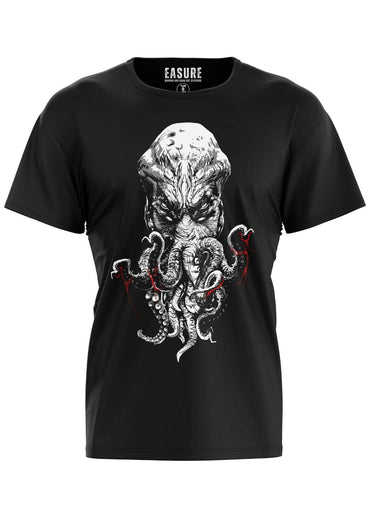
No symbol is more strongly associated with Lovecraft than Cthulhu. The colossal creature with a tentacled head, dragon-like wings, and gigantic form first appeared in the 1928 story "The Call of Cthulhu."
For many fans, Cthulhu embodies:
- The Unknown
- Ancient Power
- Secret knowledge
- The limits of human perception
Today, the creature is one of the most famous icons of alternative culture and is frequently found on Gothic jewelry, clothing, and artworks.
Lovecraft's influence on Gothic fashion
The dark and mysterious atmosphere of his stories continues to influence numerous designers and artists.
Typical elements of Lovecraft-inspired Gothic fashion include:
- Tentacle motifs
- Occult symbols
- Ancient script
- Mystical seals
- Ancient maps and star constellations
- Decaying architecture
- Dark color palettes
Jewelry with Cthulhu motifs, cosmic symbols, or mysterious runes are particularly popular within the Gothic scene.
Lovecraft and the fascination of the forbidden
A central theme of his works is the pursuit of knowledge.
His protagonists frequently encounter:
- Lost books
- Secret cults
- Forbidden rituals
- Ancient truths
The fictional "Necronomicon," a forbidden book full of dark secrets, is particularly well-known. The symbolism of hidden knowledge is still found in many areas of Gothic culture today and forms an important part of its fascination.
Why Lovecraft is more relevant today than ever
Although his stories were written over 100 years ago, many of his themes seem strikingly modern.
In a world full of technological developments and unknown future questions, his works address fundamental human fears:
- The fear of the unknown
- The search for truth
- The limits of human knowledge
- The meaning of the individual in the universe
Conclusion: Lovecraft's legacy in the Gothic world
H. P. Lovecraft created far more than classic horror literature. His vision of cosmic horror has influenced fashion, music, art, and literature for decades.
The themes of his works perfectly match Gothic culture, which deals with mysticism, darkness, hidden truths, and existential questions.
From Cthulhu jewelry to dark wave music and modern fantasy art, his influence extends into the present day. Lovecraft thus remains one of the most important figures for all who are fascinated by the mysteries of the unknown.
Frequently Asked Questions about Lovecraft and Gothic
Who was H. P. Lovecraft?
H. P. Lovecraft was an American writer and the founder of cosmic horror. His works are now considered among the most important influences in modern horror and Gothic culture.
What is cosmic horror?
Cosmic horror describes stories in which humans are confronted with ancient and incomprehensible powers. The insignificance of humanity in the universe is central.
Why is Cthulhu so famous?
Cthulhu is the most famous figure from Lovecraft's mythos and symbolizes the unknown, ancient power, and cosmic horror.
How does Lovecraft influence Gothic culture?
His themes such as mysticism, madness, hidden truths, and dark aesthetics continue to shape Gothic fashion, music, art, and jewelry designs.
Prev post
Millennials in the Goth Scene - Everything Used to Be Gloomier
Updated on 09 June 2026
Next post
Meaning of Pentagram Jewelry
Updated on 09 June 2026