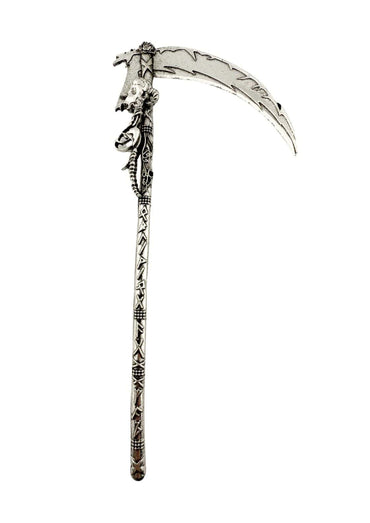
The Grim Reaper has been with you since childhood: in fairy tales, horror films, games, metal artwork, and on gothic shirts. He represents death, transience, nightmares – and at the same time, style, symbolism, and identity. In this glossary entry from EASURE, you'll delve deep: What is the Grim Reaper, where does he come from, what are his cultural, spiritual, and gothic meanings – and how can you powerfully incorporate this motif into your aesthetic?
What exactly is the Grim Reaper?
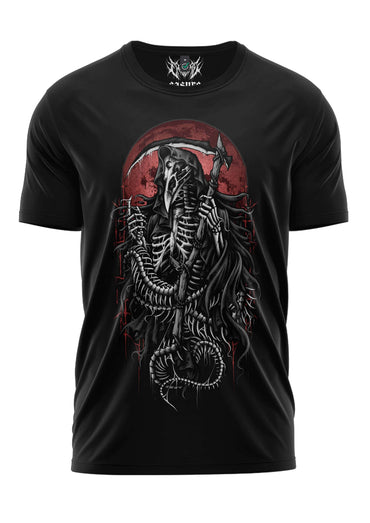
When you speak of the Grim Reaper, you mean the personified figure of death . In Europe, he has appeared since the Middle Ages as:
- skeletal figure
- in a black robe with a hood
- with a long scythe in his hand
- often with an hourglass or hourglass
This figure "mows down" the living like grain. The idea sounds brutal, but it fits perfectly into an agrarian world: whoever harvests the field with a scythe also "harvests" life. From this imagery arises the iconic figure that you find today on tarot cards, album covers, and Gothic clothing.
The Grim Reaper is not a single deity , but an allegory : a pictorial representation of death, mortality, and transition. He connects:
- medieval Dance of Death depictions
- Christian end-times beliefs
- older mythological images such as goddesses of fate, gods of death and guides of souls
For the Gothic subculture, the Grim Reaper functions as a powerful symbol : He breaks the taboo of death, he brings the uncomfortable to the forefront, he reminds us of transience – and at the same time he provides a visually extremely clear icon.
Names, synonyms and variants: What else is the Grim Reaper called?
The figure of the Grim Reaper has many names, depending on the region and cultural context. If you delve deeper into the symbolism, you will encounter, among other things:
- Death / Godfather Hein
-
Friend Hein – an almost friendly, ironic name
-
Bone Man , Boandlkramer (Bavarian/Austrian)
- In English: Grim Reaper
- In French: la Faucheuse (often meant to be female)
Similar figures exist in other cultures:
-
Thanatos – god of death in Greek mythology, sometimes depicted with a scythe
-
Shinigami – death gods or death spirits in Japanese tradition
-
Santa Muerte – a folk saint in Mexico, a skeletal figure in a cloak
These names show how the Grim Reaper appears in different guises around the world. You immediately recognize: The figure is flexible, changeable, but the core remains the same – a personified boundary between life and death.
Origin and history: Where does the image of the Grim Reaper come from?
Middle Ages, Plague and Dance of Death
The classic European Grim Reaper emerged in the late Middle Ages . Three factors in particular shaped his image:
Plague and epidemics
Entire city districts were repeatedly dying. Death was omnipresent, brutally visible, and could no longer be romanticized. Artists reacted with drastic images: skeletons, decaying bodies, scenes of the Dance of Death.
Dance of Death depictions
In frescoes, woodcuts, and church paintings, Death dances with people of all classes – from beggars to queens. Death often carries a scythe or sickle. Here, the motif of the "Reaper," who collects everyone without distinction, prevails.
Ancient mythological motifs
From antiquity, you know goddesses who cut the threads of life and gods who appear with sickles or scythes. This imagery merges with Christian concepts of the afterlife to form the figure that later became known as the Grim Reaper .
In the 15th century, this evolved in art into the depiction of the naked or shrouded figure of the Grim Reaper slaying a bone with a scythe . Later, the long, black hooded robe was added, which you associate with the modern Grim Reaper.
From sickle to scythe
The step from sickle to scythe is not only visually, but also symbolically powerful:
- The sickle cuts individual stalks.
- The scythe mows large areas.
The Grim Reaper thus represents not only individual death , but also mass death: war, plagues, catastrophes, the "harvest" of entire generations. This image unfolds its full power particularly in the context of the plague, the Thirty Years' War, and religious conflicts.
Iconography of the Grim Reaper: scythe, robe, hourglass
The scythe – tool and weapon
The scythe is the Grim Reaper's central attribute and is even part of his name. Symbolically, it represents:
- Harvest and end of a cycle
- radical cut – there is no going back
- Equality before death (the scythe makes no distinction)
If you wear a Grim Reaper tattoo , a shirt, or jewelry with a scythe, you are conveying these levels: You are playing with harvest, transience, and a clear, merciless end.
The hooded robe
The black robe with its low-set hood serves several functions:
- It anonymizes death – no face, no mercy
- It is reminiscent of monks and religious robes , thus of religion and the afterlife.
- It creates a strong contrast to the surroundings : black outline, immediately recognizable.
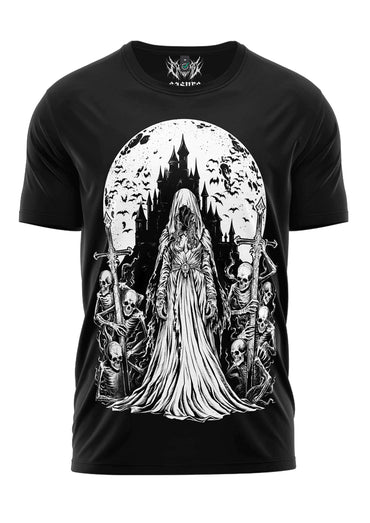
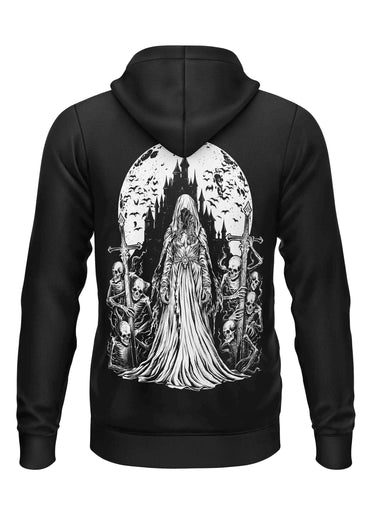
Exciting for Gothic fashion: These very shapes – hoods, long silhouettes, deep black tones – are incorporated into many hoodies, zip-up jackets, and robe-like cuts . In the Gothic Clothing Hoodies category, for example, you'll find pieces that embrace the dark, concealing look.
hourglass and hourglass
Besides the scythe, the Grim Reaper often carries an hourglass or an hourglass. This attribute visualizes:
- remaining lifespan
- irreversible process – the sand keeps trickling, no matter what you do.
- The memento mori motif: "Remember that you are mortal."
The combination of hourglass and bone hand is one of the most popular motifs in dark art illustrations, pins and prints.
Meanings: What does Grim Reaper mean?
The Grim Reaper appears simple, but carries multifaceted meanings that are particularly exciting for Gothic culture, Dark Art and alternative aesthetics.
Death and transience
Clearly, death is central. The Grim Reaper:
- marks the boundary between life and death
- It reminds us of the finiteness of all things.
- destroys any illusion of control and immortality
Gothic culture consciously deals with topics that others suppress. Wearing the Grim Reaper symbol shows: "I don't repress this, I look at it."
Justice and equality
The Grim Reaper makes no distinctions . He takes the poor and the rich, the outsiders and the powerful, the sympathetic and the unsympathetic. In this sense, he represents:
- a radical form of equality
- a counterweight to earthly hierarchies
- a dark but clear form of "justice"
For a scene that opposes class arrogance, racism and exclusion, this motif fits surprisingly well: Before death, all titles lose their value.
Transformation and new beginning
In modern symbolism and dream interpretation, the Grim Reaper often represents:
- End of a life phase
- Letting go of old patterns or relationships
- The beginning of a new development after a “symbolic death”
Many who move in alternative scenes have experienced precisely such ruptures: leaving toxic environments, breaking with mainstream expectations, building a new lifestyle. The Grim Reaper thus becomes a symbol of liberation , however paradoxical that may sound.
Humor, irony, and distance
Contemporary cartoons, memes, and comics also use the Grim Reaper humorously. He intervenes in everyday stories as a darkly humorous figure. This results in:
- an ironic distance to one's own death
- one way to reduce anxiety
- a playfulness that perfectly fits pop culture
This ironic perspective also shapes many Gothic Grim Reaper motifs : the skeleton with a coffee cup, the chilling Grim Reaper figure on the sofa, the Grim Reaper as a festival guest – dark, but with a wink.
The Grim Reaper in religion, mythology, and folk belief
Christian images and death as "brother"
There is no official "Grim Reaper doctrine" in Christianity, but art and folk belief use this figure to illustrate biblical themes:
- the end times and the Last Judgment
- Angels as reapers , who "harvest" souls
- Parables in which the world and people appear as a field
Later authors refer to death as Brother or Friend Death . Death then acts not only as an enemy, but also as:
- Savior from suffering
- natural part of the divine plan
- An unavoidable companion that will knock at any time.
This ambivalence is what makes the Grim Reaper so fascinating: he stands between terror and peace.
Pagan, folk magic and alternative spirituality
In pagan and esoteric movements, the Grim Reaper appears less as a Christian figure, but rather as:
- Archetype of Transformation
- Guardians of the Threshold Between Worlds
- Companions at rituals for Samhain, All Hallows' Eve or funeral rites
The motifs here combine skulls, scythes, ravens, crows, cemetery scenes, and tarot. If you are interested in pagan and death symbolism , it's worth taking a look at our Pagan section in the Gothic universe , where you will find many related symbols.
Regional legendary figures
The Grim Reaper mingles with regional ghostly and deathly figures:
-
Dengelgeist – the legendary figure who sharpens his scythe in the cemetery
- Cemetery ghosts, black dogs, bone men
- local “men with scythes” who announce certain events
Such figures quickly become associated with collective anxieties and serve as a projection screen for societal unrest. This is precisely where modern dark art comes in.
Grim Reaper in English: the Grim Reaper
Many memes, films, and games don't refer to the "Grim Reaper" but to the Grim Reaper . This is the English equivalent, roughly meaning "dark reaper." Typical characteristics:
- black robe with hood
- long scythe
- Sometimes a skeletal face, sometimes an invisible face in the shadows
- occasionally hourglass, black crows or ravens
"Grim Reaper" is so dominant in global pop culture that it also has an impact on the Gothic scene in German-speaking countries. You'll recognize it immediately on English-language band shirts, metal album covers, or at international festivals.
This gives you additional creative freedom for a tattoo or shirt design: You can combine lettering such as "Grim Reaper", "Death" or "Memento Mori" with classic Grim Reaper elements.
The Grim Reaper in art, literature, film and games
Grim Reaper in art and literature
The Grim Reaper has been a recurring figure since the Middle Ages:
-
Dance of Death cycles on church walls
- Illustrations in Books of Hours and Bibles
- allegorical poems and songs in which death appears as the reaper
Later, he appears in comics, graphic novels, and dark art series. Many Gothic artists use the Grim Reaper to:
- to tell their own stories about death and existential crises
- to make critical statements about war, capitalism, or environmental destruction
- to process personal experiences with loss, depression or illness
This keeps the character alive and allows it to change with each generation.
Grim Reaper in the film
Searching for "Grim Reaper film" will yield everything from dark horror and fantasy to comedy. Typical roles:
-
Death as a character : speaks, negotiates, tricks, takes souls.
-
Symbolic figure : appears wordlessly in key scenes, stands in the background, accompanies disasters.
-
Parody : Grim Reaper with an office job, Death as an overwhelmed employee, a silent supporting character with dark humor.
In the Gothic scene, film Grim Reapers serve as a source of inspiration: you see variations of masks, robes, and props and apply them to Grim Reaper costumes , makeup, tattoos, or designs. Film-loving Goths should also check out our reviews of horror classics , where you'll find further inspiration for a dark aesthetic.
Grim Reaper in video games
Games often use the Grim Reaper as a symbol of:
- Boss enemies
- NPC who appears on the death screen
- playable character in hack-and-slash titles
- humorous character who negotiates with the game character
The fact that the Grim Reaper appears in games where you regularly die and resurrect reinforces his status as a gatekeeper between level and game over, between run and restart . For gamers in particular, death symbolism and pop culture combine here to create a familiar yet ever-present threat.
Grim Reaper in the Gothic universe: symbol, statement, style
Why the Grim Reaper fits into the Gothic scene
The Gothic subculture revolves around themes such as:
- Darkness and melancholy
- Romanticizing transience
- social outsider roles
- Criticism of superficial mainstream glamour
The Grim Reaper is a perfect fit because he:
- brings the taboo of death aggressively onto the stage
- not hiding the darkness , but celebrating it as an aesthetic space
- The absurdity of empty status symbols is exposed ("in the end, all bones are used up")
Especially in combination with skulls, spiderwebs, coffin shapes, and witch symbols , a symbolic cosmos emerges that provides a clear framework for your identity. In our themed world – The Grim Reaper in the Gothic Universe – you will find precisely this concentrated visual language.
Aesthetics: How the Grim Reaper works as a motif
Shapes, lines and contrasts
For artists , tattoo artists and designers, the Grim Reaper offers a strong visual structure:
- Silhouette of the scythe – long, curved bow, clear blade
- Hood – dark focal point, staring out of the eyes or void
- Skeletal forms – ribs, skull, bones as line patterns
- Draping – flowing robes, fluttering fabrics
These elements create striking outlines and strong black and white contrasts that are a perfect match for screen printing on organic cotton – something we consistently use at EASURE.
Emotional impact
Depending on how it is depicted, the Grim Reaper evokes different moods:
- menacing, brutal – large, sharp scythe, harsh contrasts
- melancholic – silent Grim Reaper at the grave, hourglass, falling leaves
- playful – chibi Grim Reaper, cartoon characters, humorous texts
- Epic – Reaper on horseback, apocalyptic landscape, flames, ruins
Grim Reaper makeup: Make-up for Halloween, festivals and photoshoots
Basic principles of Grim Reaper makeup
The "Grim Reaper makeup" motif appears every year at Halloween. This look is also suitable for Gothic events, photoshoots, or dark performances. Typical elements:
- extremely pale or white face
- Strong contours around the eye sockets, cheekbones, and jaw.
- black or very dark areas around the eyes, "emptiness" in the gaze
- emphasized bone lines, some teeth painted on the mouth
This creates a skeletal, otherworldly effect without completely encasing yourself in latex masks.
Styling tips from a Gothic perspective
For an aesthetically pleasing result:
- Use matte black and grey eyeshadow for depth.
- Draw the eyebrow area darker and sharper to increase the sense of menace.
- Use black eyeliner or kohl to draw cracks, lines, and shadows.
- Combine the make-up with a hood, veil or hat so that the face “floats” in the dark.
Breaking up the look with vibrant hair colors creates an exciting clash between the classic death symbol and modern alternative culture. Find inspiration for hair colors in our section on vibrant hair dyes from Directions & Co. – perfect if your Grim Reaper has poison green or blood-red lengths.
Grim Reaper tattoo: meaning, motifs, composition
Why people get the Grim Reaper tattooed on themselves
A Grim Reaper tattoo makes a powerful statement. Common motivations:
- Remembering death as a motivation to live intensely
- Coping with grief or loss
- Visualization of a personal new beginning after an “inner death”
- An expression of differentiation from superficial lifestyles
Death on the skin means: You accept the end and consciously shape what happens before it.
Popular tattoo variations
Typical Grim Reaper tattoo styles:
-
Traditional / Old School : thick lines, clear colors, scythe, banners with lettering
-
Blackwork : completely black surfaces, strong contrasts, minimalist Grim Reaper
-
Realistic : detailed bones, fabric folds, skull, glowing eyes
-
Neo-Traditional : Reaper combined with flowers, animals, symbols, and bold colors
Many associate the Grim Reaper with:
- watches or hourglasses
-
Roses (Love & Death)
- Ravens, crows, bats
-
Coffin shapes , tarot cards, runes
If you are active in the tattoo community or create artwork, you will find inspiration for linework, contrasts and symbol combinations in EASURE's range of pins, shirts and hoodies with dark art motifs .
How to draw the Grim Reaper: Tips for artists and creatives
Basic structure for drawing the Grim Reaper
If you're looking for information on how to draw the Grim Reaper, you're probably searching for the basics of how to stylishly depict the subject. A sensible order of steps:
Define silhouette
First draw the basic shape: robe, hood, posture, scythe as a diagonal line.
Establish body language
Decide: Threatening (upright scythe), thoughtful (scythe supported like a staff), calm (arms lowered).
Add details
Bone hands, skulls, fabric folds, chains, tears in the fabric, background elements (gravestones, moon, fog).
Planning contrasts and light sources
Deliberately place highlights on the blade and bone, and let parts of the figure disappear into shadow.
Styles for Reaper Art
Depending on the desired effect:
-
Minimalist : just the outline of the robe, a simple scythe – ideal for logos, patches, pins.
-
Comic / Chibi : big head, small scythe, cute expression – perfect for humorous pins or stickers.
-
Dark Realism : detailed, gloomy textures, fog, smoke, light rays – great for posters and album covers.
Grim Reaper's scythe: From tool to cult object
Historical scythe
Historically, the scythe is a:
- agricultural tool for mowing grass and grain
- Symbol of hard physical work
- quiet, recurring noise in fields
In the context of the Grim Reaper, the meaning shifts: The scythe does not mow stalks, but lifelines .
The scythe as a symbol in the scene
For Gothic, Metal and Dark Art aesthetics, the scythe becomes:
- Grim Reaper's distinguishing features
- stylizable object with clear lines
- Carriers for runes, symbols or inscriptions on the blade
In designs for shirts, hoodies, stickers, patches, and pins, the scythe often plays the main role, while the Reaper himself remains a shadowy figure in the background. This creates a more abstract, yet extremely powerful visual language.
The Grim Reaper as a psychological symbol
Fear, control, and acceptance
Psychologically, the Grim Reaper embodies:
- your fear of losing control
- the realization that life is finite
- the conflict between repression and acceptance
Those who consciously surround themselves with this figure send a clear signal: "I will not let fear paralyze me, I am looking." For many people, this has a liberating effect, especially after crises.
Shadow work and self-image
In psychology, people often talk about "shadows," meaning aspects of ourselves that we don't want to see. The Grim Reaper brings these shadows to light.
- transience
- Aggression, death wishes, destructive impulses
- Feelings of guilt, fear of loss
By using the motif as art, a tattoo, clothing, or decoration , you create a projection surface. You actively shape your shadow of death—instead of letting it operate in your subconscious. This perfectly aligns with the self-image of many Goths: consciously confronting pain, loss, and darkness.
The Grim Reaper in everyday life: How to consciously use the motif
Discreet integration
If you want to live with the motif without looking permanently in costume:
-
Delicate jewelry featuring skulls or coffins subtly references the Reaper.
- A subtle Reaper print on a high-quality shirt showcases your theme without looking like "fast fashion Halloween".
-
Home decor featuring scythe silhouettes, references to the Dance of Death, or Vanitas motifs brings aesthetics into your home.
Frequently asked questions about the Grim Reaper
What's the Grim Reaper's name again?
The Grim Reaper goes by many names depending on the region and context. In German, you'll encounter Gevatter Tod , Gevatter Hein , Freund Hein , Knochenmann, or, regionally, Boandlkramer . In English, the Grim Reaper is usually called the Grim Reaper , and in French , la Faucheuse . These synonyms always refer to the same basic figure: a personified figure of death with a scythe, often in a black robe.
Is the Grim Reaper an angel?
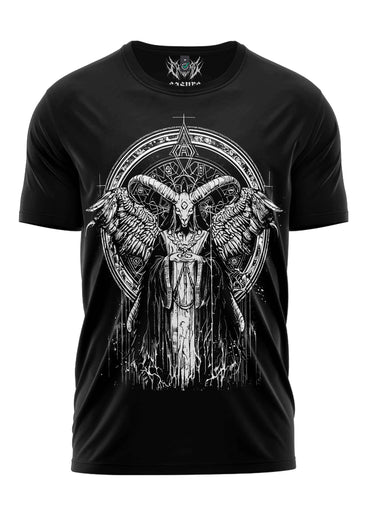
In classical doctrine, the Grim Reaper is not an angel in his own right, but an allegory of death . In some depictions, however, he appears angelic: he has wings or assumes the functions of a guide of souls , similar to an angel of death. Fine art and popular culture blur these roles, so that the Grim Reaper sometimes appears as a fallen or gloomy angel, accompanying souls with a scythe and hourglass.
What does "Grim Reaper" mean?
The term Grim Reaper refers to the personified representation of death as a reaper with a scythe . The scythe symbolizes the "mowing" of life's threads, the end of the life cycle. The Grim Reaper therefore signifies death, transience, and inevitable finitude. At the same time, in Gothic culture and Dark Art, he also represents transformation, a new beginning after a symbolic end, and the conscious confrontation with themes that society prefers to suppress.
Why is death called the Grim Reaper?
Death is called the Grim Reaper because the image originates from an agrarian world: someone walking across a field with a scythe harvests many stalks in one go. Artists and storytellers transfer this image to dying: death "mows down" human lives like grain. From this, the figure of a man with a scythe—the Grim Reaper—developed in art history, symbolically ending life and, as it were, gathering the "harvest" of mortals.
What is the difference between the Grim Reaper and the Reaper?
In terms of content, there is no fundamental difference: "Resenmann" is the German term, "Grim Reaper" the English variant. Both refer to a skeletal or shrouded figure in a black cloak, wielding a scythe. Only the style and cultural context differ in detail. The Grim Reaper appears more frequently in English-language films, series, and games and speaks English; the Resenmann is more commonly found in German-language literature, fairy tales, and folklore. For tattoos, costumes, Reaper costume ideas, and dark art designs, both figures function practically identically.
What is the meaning of a Grim Reaper tattoo?
A Grim Reaper tattoo symbolizes on your skin that you are consciously confronting death and mortality. It can represent memento mori – the reminder that you only have a limited time – the processing of a loss, the end of a phase of life, or a radical form of freedom: "I know that death is coming, so I live my own life." In the tattoo scene, a Reaper motif often combines elements such as hourglasses, roses, or skulls to reinforce this layer of meaning.
How can I stylishly integrate the Grim Reaper into my Gothic look?
You can stylishly integrate the Grim Reaper look by using it sparingly : A bold Grim Reaper shirt, combined with simple black trousers, a coffin pendant, and dark hair accessories, looks clean and not overdone. For more subtle looks, a reaper pin, a small scythe symbol on a gothic sweatshirt, or a coffin piece of jewelry will suffice. If you're planning a complete Grim Reaper costume, choose a robe or hooded hoodie, complementary makeup or a mask, and a symbolic scythe—and then wear the same pieces individually in your everyday life.